LeadGuitarWorkshop.ws Page 5
Lynyrd Skynyrd rocking out at the Big State Festival in College Station, Texas, October 13, 2007. 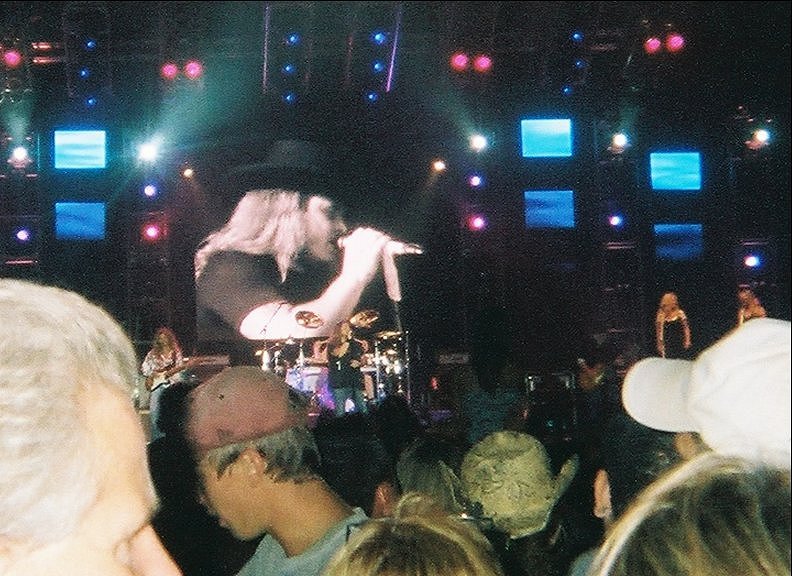
On this page: guitar lessons covering Double-Stops, Hendrix Octaves, the Pentatonic Scale, Trills, Neighbor Tones, and the relationship of the Pentatonic Scale to the Church Mode Scales.
Guitar Lesson #9 - 5-Root Double Stops
A Double Stop is where you either play two notes at the same time or two notes timed closely together; the two notes are on different strings, not the same string. This is often done combined with sliding from one position to the next.
This next audio example uses the following patterns slid to various positions. Think of these as two note power chords, only inverted so that the Root note is on the right:
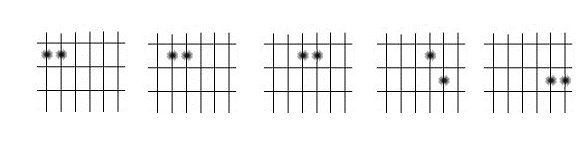
Double Stops, minor scale audio example:
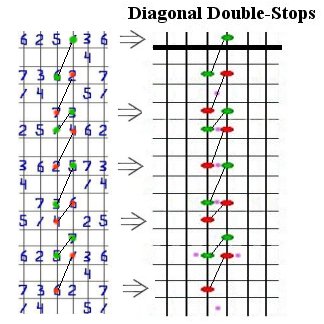
Playing In 3rds (Diagonal Double-Stops)
Playing in 3rds is especially prevalent in Country Music, but is also useful in Rock - for instance listen to Slash's intro in Guns & Roses' "Night Train." The pattern shown here is for E-minor. I usually tune my guitar down to D (approximately) to make vocals easier to sing, so that's the key you'll hear in the audio examples. Each of these diagonal patterns is either a Root-3 or a Root -flat 3 (aka, a Major-3rd interval or a minor-3rd interval) :
Guitar Lesson #10 - Hendrix Octaves
This is a special type of Double-Stop. The two notes being played at the same time are the same note, only one is an octave higher than the other. There will be a string in-between the two that are being played that will have to be muted. Made famous by Jimi Hendrix, the two notes being played simultaneously will have the following pattern which is moved to various positions:
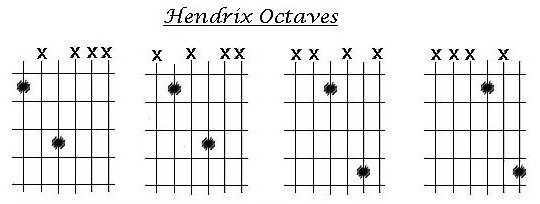
Hendrix Octaves, minor scale audio example:
The Pentatonic Scale
The Pentatonic Scale only has 5 tones instead of 7. Its basic Number Pattern is as follows:
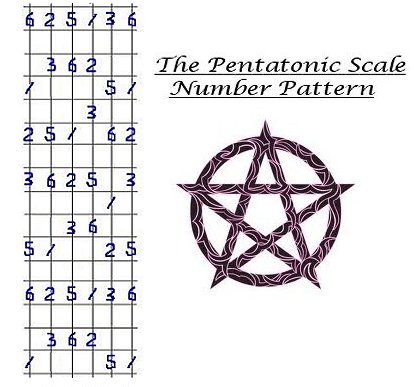
For the minor-Pentatonic Scale; start on a 6 and end on a 6.
For the Major-Pentatonic Scale, start on a 1 and end on a 1.
If all the 6's are "E" notes, then you are playing an E-minor
Pentatonic scale
If all the 6's are "A" notes, then you are playing an A-minor
Pentatonic scale
If all the 6's are "G" notes, then you are playing a G-minor Pentatonic
scale
etc.
If all the 1's are "E" notes, then you are playing an E-Major
Pentatonic scale
If all the 1's are "A" notes, then you are playing an A-Major
Pentatonic scale
If all the 1's are "G" notes, then you are playing a G-Major
Pentatonic scale
etc.
The Pentatonic Scale - Box PatternsThe Pentatonic number pattern translates into 5 "Box Patterns" which stack on top of one another as follows:
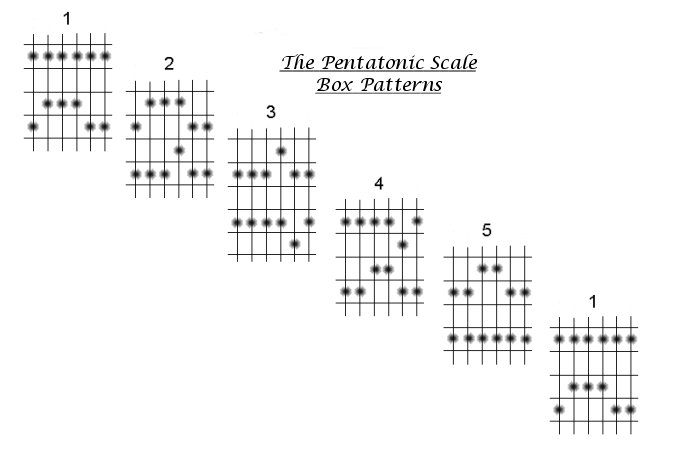
Note how the Pentatonic patterns in the above graphic overlap - the bottom notes of one pattern are the top notes of the next pattern.
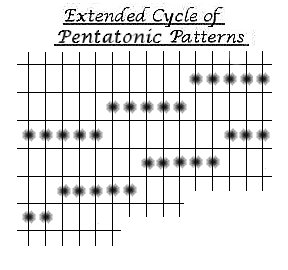
Extended Cycle of Pentatonic Patterns
As with the Church Modes, the Pentatonic Scale has a pattern which continuously repeats; I call this the "Extended Cycle of Pentatonic Patterns." If you had a guitar with an infinite number of strings all tuned in forths, this is the Pentatonic Pattern you would come up with. Observe how all of the Pentatonic Scale Box Patterns fit somewhere into the following Extended Cycle if you make the adjustment of shifting up one fret higher in tone when you land on the "B" string:
Guitar Lesson #11 - Trills
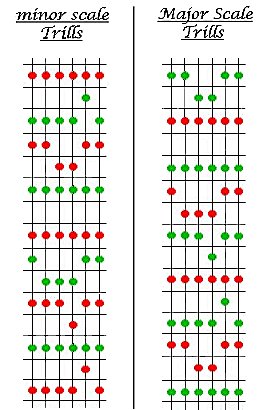
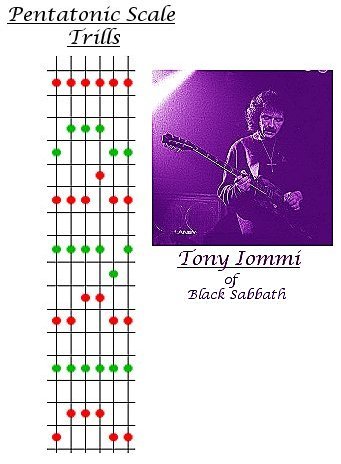
A "Trill" is where you play two notes sequentially, repeatedly; the two notes are on the same string, not different strings. The Trill is usually played fast; this can be done either one-handed using hammer-ons and pull-offs, two-handed using finger-tapping, or two-handed using the side of your pick or some other object. Typically each pair of notes is Trilled 2, 3, or 4 times (for a total of 4, 6, or 8 notes played) at each tone position.
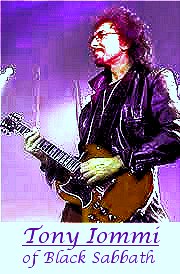
Tony Iommi of Black Sabbath exemplifies the one-handed Trill technique utilizing the technique all over the fretboard, primarily in the context of Pentatonic scales; he is not, however, a Pentatonic purist - he will also occasionally Trill vertically adjacent notes (ie, notes that are next to each other on the same string) from a Church Mode scale or even Trill Chromatic Scale notes.
Tony Iommi, who is a left-handed guitar player, lost the tips of his left hand index and ring fingers in a work-related accident early in his career. To compensate, he started using prosthetic fingertips which I believe is how he is able to achieve very fast Trills single-handed rather than using two-handed techniques. In this next graphic, you Trill each pair of red and green notes that are on the same string:
Combining Pentatonic Scales with The Church Modes
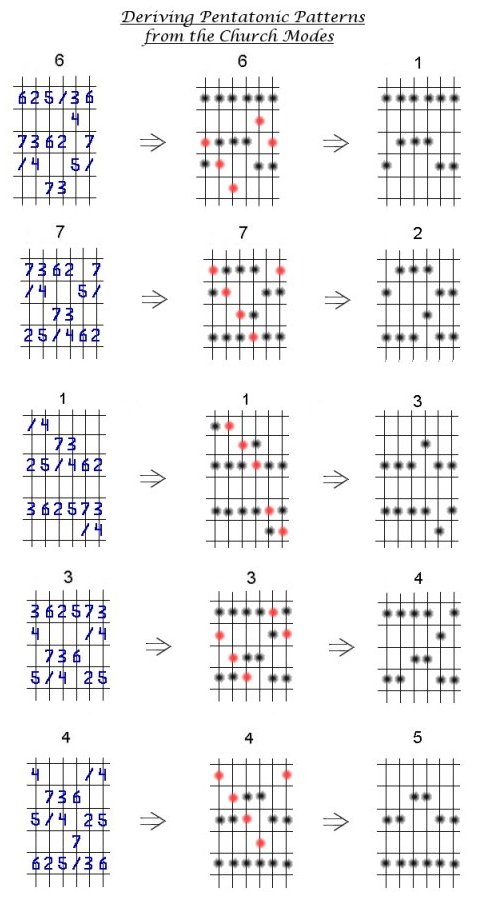
The 5 Pentatonic Patterns are actually derived from the Church Mode Patterns by leaving out all the Church Mode 4 and 7 notes as shown below. What this means is that you can go from playing Pentatonic scales to playing Church Mode scales simply by including the "extra" notes or you can go from playing Church Mode scales to Pentatonic scales by excluding the "extra" notes:
* * * * * * * * * * * * * * * * * * * * * * * * * * * * * * * * * * * * * * * * * * * * * * * * * * * * * * * * * * * * * * * * * * * * * * * * * * * * *
Guitar Lesson #13 - Neighbor Tones
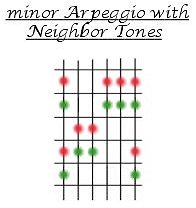
A "Neighbor Tone" is the tone one fret lower in tone than the reference tone. For a Neighbor Tone enhancement of an Arpeggio, you would trill every note of the Arpeggio with the note one fret lower in tone; Neighbor Tones fit in well with Diminished Scale patterns. In this next graphic, the main Arpeggio pattern is the green dots. What you do is trill each green note with the red note one fret lower in tone:
minor arpeggio with Neighbor Tones
audio example:
Continued on Page 6.
* * * * * * * * * * * * * * * * * * * * * * * * * * * * * * * * * * * * * * * * * * * * * * * * * * * * * * * * * *
Return to Top of this page.
Guitar Lesson #12
Finger-Tapped Trilled Church Mode Scales
This is perhaps my favorite technique, which is the same technique as Pentatonic Scale Trills, only now we are applying it to the Church Mode Scales; what I do is hold down one note of a scale with my left hand and repeatedly tap (ie, "trill") the next higher note of the scale on the same string with my right hand index finger; then move to other scale degree positions and trill each pair of vertically adjacent notes. Trills can also be done using the side of your pick or entirely one-handed as exemplified by Tony Iommi of Black Sabboth who pioneered the Trill technique.
In this side graphic you Trill each pair of red and green notes that are on the same string.
In this next video, I'm Trilling the notes using half of a clothes pin: |
|
|