LeadGuitarWorkshop.ws Page 1
Free guitar lessons - on this website I explain lead guitar improvisation. I will demonstrate the implementation of Music Theory to lead guitar solos using diagrams and audio examples. I will show you how to play lead guitar easily, musically, confidently, & competently to create your own guitar solos.
Guitar techniques and subjects covered include misc guitar scales, guitar playing techniques,
& Music Theory:
Page 1: The Church Modes, Alternate-Picking, Speed Scales, Triplet Rolls,
Box Patterns, & Sequencing (Digital Picking)
Page 2: More Sequencing
Page 3: Pedal-Point & Finger-Tapping
Page 4: Arpeggios
Page 5: Double-Stops, Playing In 3rds, Hendrix-style Octaves, The Pentatonic Scale,
Trills, & Neighbor Tones
Page 6: Trilling the Church Modes, The Chromatic Scale, Intervals & Chord Formulas,
Vibrato, String-Bending, The Blues Scale, The Augmented Scale,
The Diminished Scale, The Harmonic Minor Scale, & The Gypsy Scale
Page 7: Some Original Songs, A long lead example using these techniques, General Comments &
Suggestions, Dual Lead, Shredding, String-Skipping, Pentatonic-Arpeggios,
a list of Some Songs That Have Great Guitar Solos, a list of Some Famous
Guitar Players, and The Keys To Musical Success.
Gear: Equipment I've used - Guitars, Amps, Effects Pedals, Electronic Drums,
Mics, & Mixers.
Market: Slow-Down Software, Ear Training Courses, Home Recording Courses
Feedback Leave your comments.
Lead guitar is both an art and a science. First I will discuss the science or technical side of playing lead.
Trilling a minor scale
video example:
(There are more Video Examples further down demonstrating the
guitar techniques explained in the text)
For a lead part to sound acceptable and not weird or discordant, the notes played should be in the same Key as whatever chord progression the rhythm guitar or rhythm section is playing. Two things have to be determined:
1) what is the Root tone (or simply "Root") of the song or progression.
2) is the song or progression minor, Major, or some other "mode" such as Dorian or Phrygian.
The Root of a song or song passage will be some tone that the song or passage keeps returning to. Usually the Root tone will be the first and last tone of a song or song passage.
Typically, the chord progression being played by the rhythm guitar or rhythm section will start and end on the Root tone, for instance, a typical progression is: Am, F, Dm, F, Am. The first and last chords are "A" and they are minor chords, so the Root is "A" and it is some kind of minor progression, probably A-minor, but it could possibly be some other minor type such as A-Dorian, A-Phrygian, or A-Locrian.
Here's another example: suppose the rhythm guitar is playing this progression: G, D, Em, D, G. The first and last chords are "G" and they are Major chords, so the Root tone is "G" and the chord progression is some kind of Major progression, probably G-Major, but it could possibly be some other Major type such as G-Lydian or G-Mixolydian.
The Church Modes
By far the most common "modes" in Western music are Natural minor and Natural Major, but there are other modes. For historical reasons these are called the "Church Modes." There are 7 Church Modes; they are:
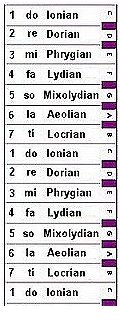
1. Ionian or Natural Major
2. Dorian
3. Phrygian
4. Lydian
5. Mixolydian
6. Aeolian or Natural minor
7. Locrian
Western music is fundamentally based upon the Natural Major scale (also called the Ionian scale) which is the familiar "do, re, mi, fa, so, la, ti, do" scale.
If the first and last tones "do" are "C" tones, then you would be singing a
C-Major scale
If the first and last tones "do" are "F" tones, then you would be singing
an F-Major scale
If the first and last tones "do" are are "G" tones, then you would be singing
a G-Major scaleLet's number each tone as follows:
1 = do
2 = re
3 = mi
4 = fa
5 = so
6 = la
7 = ti
1 = do
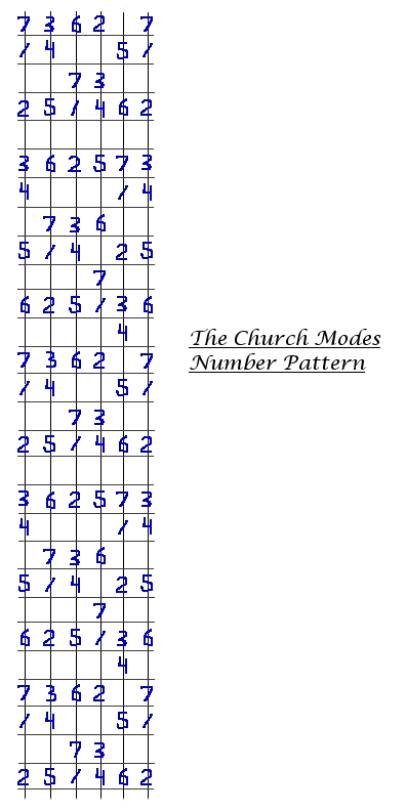
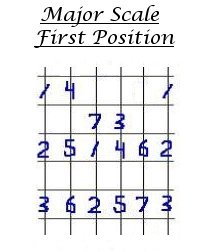
Now let's transfer these tones onto the guitar fretboard.
This graphic is to be thought of as a pattern that can be slid up or down the fretboard to the appropriate position.
In this graphic and all following graphics the vertical lines are the strings, low-E string on the left, high-E string on the right, and the horizontal lines are the frets:
If you play the notes from 1 to 1, ie, 1,2,3,4,5,6,7,1 then you are playing a Natural Major (or Ionian) scale.
If you play the notes from 6 to 6, ie, 6,7,1,2,3,4,5,6 then you are playing a Natural minor (or Aeolian) scale.
And all the other "Church Modes" are defined in the same manner:
Play from 1 to 1, ie, 1,2,3,4,5,6,7,1 for the Natural Major (or Ionian) scale.
Play from 2 to 2, ie, 2,3,4,5,6,7,1,2 for the Dorian mode
Play from 3 to 3, ie, 3,4,5,6,7,1,2,3 for the Phrygian mode.
Play from 4 to 4, ie, 4,5,6,7,1,2,3,4 for the Lydian mode.
Play from 5 to 5, ie, 5,6,7,1,2,3,4,5 for the Mixolydian mode.
Play from 6 to 6, ie, 6,7,1,2,3,4,5,6 for the Natural minor (or Aeolian) scale.
Play from 7 to 7, ie, 7,1,2,3,4,5,6,7 for the Locrian mode.
If the 1's are all "C" tones, then playing from 1 to 1, ie, 1,2,3,4,5,6,7,1 will be a C-Major scale (it could also be called C-Ionian, but C-Major is more common). Remember, a Major scale is the familiar do-re-mi-... scale. The scale, of course, can be extended more than one octave. Any way of climbing thru the notes will work; you can go up one string, go across all six strings, or any other vertical & horizontal combination as long as you keep to the given pattern of 1,2,3,4,5,6,7,1.
If the 6's are all "C" tones, then playing from 6 to 6, ie, 6,7,1,2,3,4,5,6 will be a C-minor scale (it could also be called C-Aeolian, but C-minor is more common). The scale, of course, can be extended more than one octave. Any way of climbing thru the notes will work; you can go up one string, go across all six strings, or any other vertical & horizontal combination as long as you keep to the given pattern of 6,7,1,2,3,4,5,6. Any Church Mode in any Key then can be played by moving the fretboard number pattern given in the graphic above; for instance:
Play from 6 to 6 with all the 6's being "A" tones for A-minor
Play from 6 to 6 with all the 6's being "Eb" tones for Eb-minor
Play from 7 to 7 with all the 7's being "E" tones for E-Locrian Mode
Play from 2 to 2 with all the 2's being "G" tones for G-Dorian Mode
Play from 1 to 1 with all the 1's being "D" tones for D-Major
Play from 1 to 1 with all the 1's being "C#" tones for C#-Major
Play from 3 to 3 with all the 3's being "B" tones for B-Phrygian
Play from 5 to 5 with all the 5's being "F" tones for F-Mixolydian
Play from 4 to 4 with all the 4's being "C" tones for C-Lydian
Keep in mind that for Western music (Rock, Pop, Country, etc) the Natural minor (Aeolian) and Natural Major (Ionian) scales are by far the most common modes used ("Western" in this context just means music of European descent, ie, not African, Asian, or Middle Eastern). The Phrygian Mode, the Locrian Mode, & the Harmonic Minor Scale (which isn't a Church Mode) are popular in Metal genres because they lend themselves well to the "devilish-sounding" Diminished Scale patterns. Another common scale type is the Pentatonic Scale, particularly prevalent in Rock & Blues, which I will get into later.
The Church Modes - Speed Scales
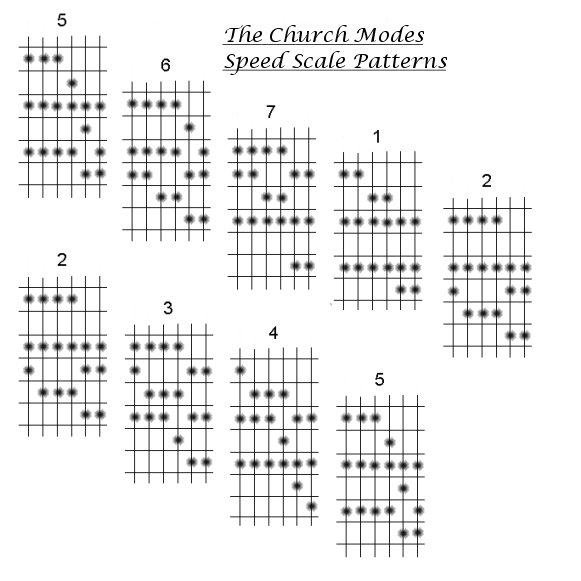
It is more practical to just memorize patterns rather than where every number is located. The way I think of scale lead patterns is shown below. In this graphic, as in all the other graphics, the vertical lines are the strings, low-E string on the left, high-E string on the right, and the horizontal lines are the frets. There are 7 different patterns. Three notes are played on each string which helps create a nice rhythm and helps with speed; these are called "Speed Scales."
Remember that if you are playing a minor scale, which will usually be the case with Rock or Heavy Metal, you will typically start with Pattern #6; if you want to play a Major scale, start with Pattern #1. Similarly, start with Pattern #2 for the Dorian Mode, start with Pattern #3 for the Phrygian Mode, start with Pattern #4 for the Lydian Mode, start with Pattern #5 for the Mixolydian Mode, and start with Pattern #7 for the Locrian Mode. Note how the patterns overlap - the last two notes on any string of one pattern are always the first two notes of the next pattern on the same string.
The Extended Cycle
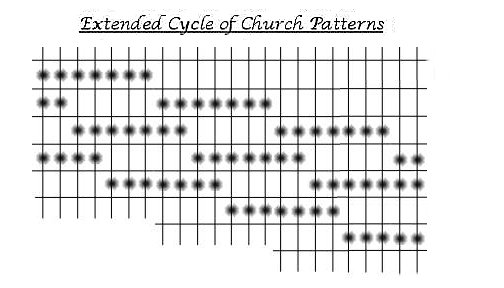
Let's imagine that we had a guitar with an infinite number of strings all tuned the same way, i.e., all tuned strictly in 4ths with no B-string change-up; if you started with Pattern #7 and kept on going, you would end up with the Extended Cycle Pattern shown below. Now if you take this Extended Cycle Pattern and place it on a normally-tuned guitar, you see all 7 of the Church Mode Patterns fall somewhere into this Extended Cycle if you make an additional shift up of one fret whenever you move to the "B" string:
The above patterns can be easily remembered by the mnemonic device: " Two up, two down, three, three, three, shift."
Emphasizing the Root Notes
The Root Notes or Root Tones are emphasized to help establish the Key of a song or passage; they are emphasized by being the starting point, stopping point, and places where you pause in a lead. Something that can help is knowing that tones of the same "flavor" are positioned diagonally on the fretboard:
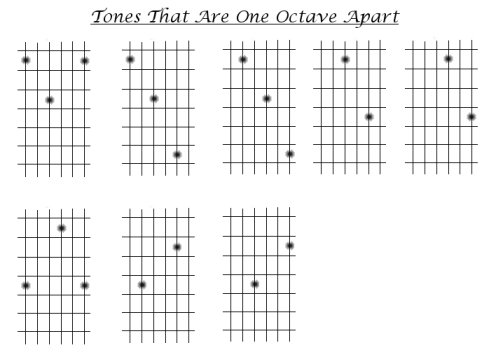
In the above graphics, going from left to right, if the first dot is an "A", then the next dot will be the 2nd octave "A", and if there is a third dot, it will be the 3rd octave "A". The same will hold true for any other tone, all three dots will be E's, G's, D's, whatever the first dot is. As in all the other graphics, the vertical lines are the strings, low-E string on the left, high-E string on the right, and the horizontal lines are the frets.
Learning your A B C's
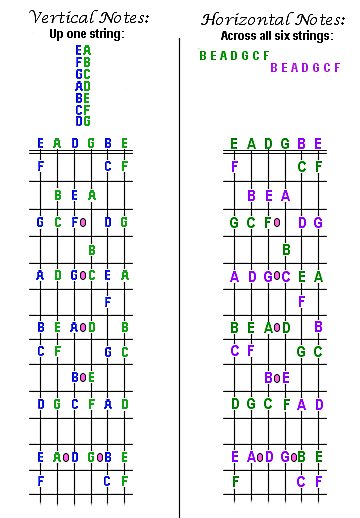
A trick that can help you remember where the notes are on the fretboard is to learn both Vertical Note Positions and Horizontal Note Positions:
Vertical Note Positions - going up one string, the notes follow the alphabet: A, B, C, D, E, F, G. Notice that the notes B&C and also E&F don't have a fret between them.
Horizontal Note Positions - going sideways across all six strings, the notes follow the pattern: B, E, A, D, G, C, F. When this cycle of notes starts over, you shift up one fret; you also shift up one fret every time you land on the "B" string:
Legato Triplet Rolls using Hammer-Ons
A Hammer-On is just where you slam your finger down on a string hard enough to make a note sound out. The Speed Scales provide a platform for playing three notes per string, called a "Triplet-Roll," as exemplified by guitarist Randy Rhoads. This is done by holding down (fretting) a note with your index finger, picking the first note, and then Hammering-On the next two notes with your ring & pinky (or middle & pinky as appropriate). You can slide up the same string to get the next group of three (this is an easy way to climb to higher positions on the fretboard) or you can move horizontally to the next string to get the next group of three notes there.
Legato Triplet Rolls using Hammer-On's & Pull-Off's
You can play the notes in reverse order, ie, play the high tone first then the middle tone then the low tone; this gives the "fig-er-oh" phrase commonly heard. This is done by using Hammer-On's & Pull-Off's. First, hold down two notes with your index & ring fingers. For the first note, Hammer-On with your pinky finger. For the second note, the pinky finger stretches the string then releases the string to sound the note being held down by the ring finger. For the third note, the ring finger stretches the string then releases the string to sound the note being held down by the index finger.
Triplet-Rolls produce a smooth, fluid, flowing kind of sound where the three notes are kind of slurred together with little individual articulation. In Music Theory, this kind of running-together of notes is called "Legato."
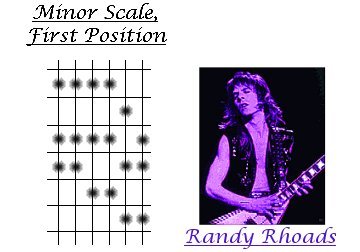
Guitar solo video example of Legato Triplet Rolls
applied to a minor scale:
Staccato & Alternate-Picking
Nowadays, the idea of Alternate-Picking is common knowledge among guitar players; back in 1983, not so much. I had played for years using just downstrokes or just upstrokes when picking notes. When I finally got around to actually taking guitar lessons, I was amazed (and a bit embarrassed for not having already figured this out) when my teacher showed me this simple technique which multiplies your playing speed exponentially. The guitar pick is alternately stroked up and down in a rhythmic fashion and another note is struck on every upstroke and on every downstroke.
Alternate-picking produces an aggressive, metallic, shredding, in-your-face kind of sound where every note is crisp, separate, & well-articulated. In Music Theory this is called "Staccato." Its important to know this so you can get in control of expressing yourself when playing. If you want an aggressive sound, do it on purpose with alternate-picking.
Picking method - here are lots of videos on YouTube on Alternate-Picking and increasing your speed - some move their wrist side-to-side, some rotate their forearm to pick, some keep the wrist and forearm rigid and move from the elbow, its even possible to keep your whole arm stiff and move from the shoulder - you'll have to experiment to find out what works for you.
Pick angle is very important to optimizing speed - you want your pick slanted in such a way that it sets you up for moving to the next string. For instance,
Example #1: slant your pick downwards towards the floor and try picking two notes per string, any two adjacent strings:
1st String, pick down,up - 2nd String down,up - 3rd String down,up - e.t.c.
You can get very fast because with the pick slanted down, the final upstroke on each string pushes away from the fretboard setting you up for the downstroke on the next string. In this case upstrokes push away from the fretboard.
Example #2: slant your pick upwards:
1st String, pick up,down - 2nd String, up,down - 3rd String, up,down.
In this case downstrokes push away from the fretboard setting you up for the upstroke on the next string.
Kudos to Troy Grady (YouTube) for cracking pick angle optimization.
If you're going to isolate and practice just Staccato and Alternate-Picking, you have to resist the urge to throw in hammer-on's and pull-off's.
The Church Modes - Box Patterns
Below is a set of Church Mode scale patterns called "Box Patterns." The advantage here is that once your hand is in position, there is very little movement needed vertically; your hand just glides across horizontally to the next string to hit the other notes, but the patterns are somewhat harder to memorize: 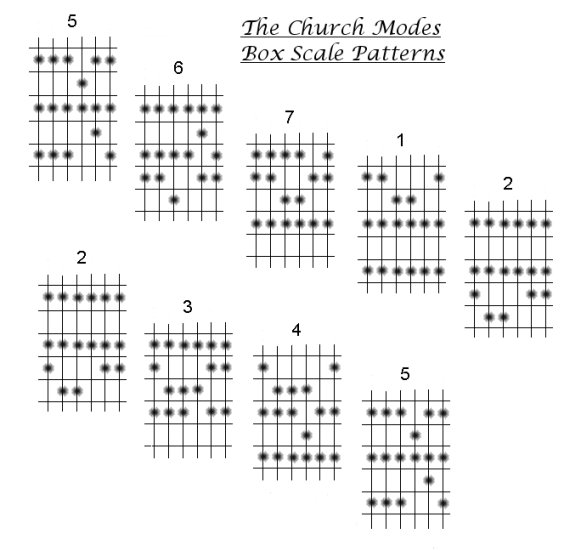
Sequencing (aka Digital Picking)
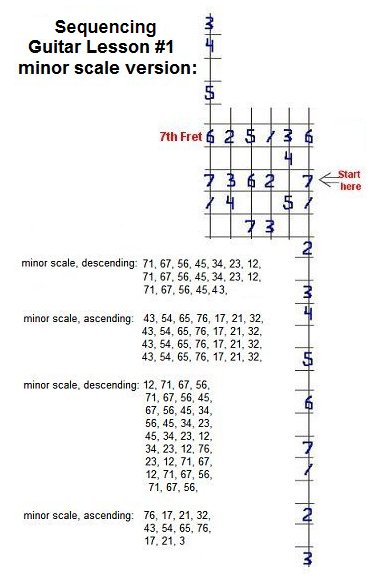
This technique is mathematical in nature. The idea is to number each tone of the scale as I did earlier in the very first graphic (ie, the Church Modes Number Pattern), and then instead of just playing the notes sequentially, you mix them up in interesting ways numerically to create a basic pattern called a "musical motif." Once a pattern (or "motif") is established, it is moved to different scale degree positions:
Sequencing Guitar Lesson #1,
Major Scale version:
Major scale, ascending: 21, 32, 43, 54, 65, 76, 17, 21
Major scale, descending: 12, 71, 67, 56, 45, 34, 23, 12
Sequencing Guitar Solo Audio Example,
Guitar Lesson #1, minor scale:
Note - I tune my guitar down one whole step (the E-strings are D).
Also, the highest "3" note is actually achieved by bending
up the highest "2" note.
Continued on Page 2.
* * * * * * * * * * * * * * * * * * * * * * * * * * * * * * * * * * * * * * * * * * * * * * * * * * * * * * * * * *
Return to Top of this page. 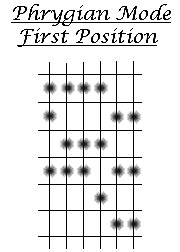
Guitar solo audio example of Triplet Rolls in the Phrygian Mode: |
|
|